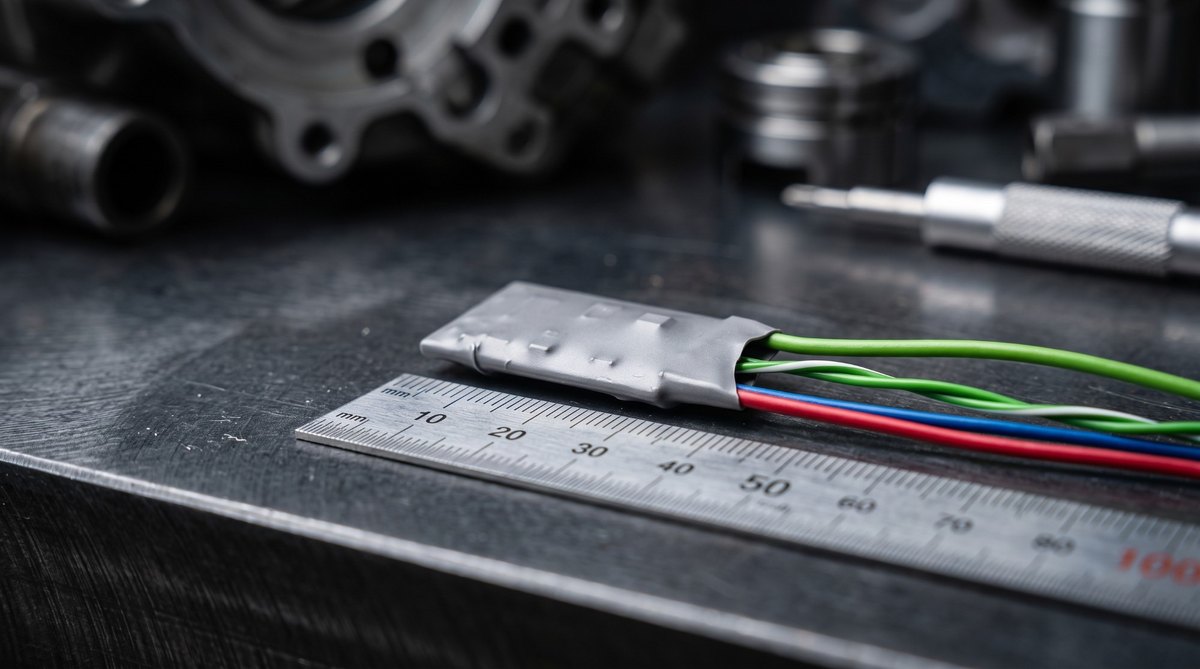
CAN-Bridge · ABS emulator · 7G-Tronic gearbox (722.9)
The Mercedes 7G-Tronic (722.9) gearbox has its own output-shaft speed sensor, so it can run without ABS data. The catch is that it then doesn't run the way Mercedes designed it to. The converter restores the full CAN communication of an emulated ABS module, so the gearbox receives the complete set of data — as in a factory vehicle.
Problem
The factory controller uses ABS/ESP data to precisely pick shift points, downshifts, traction control and smoothness. When that data is missing, shifts become less predictable, the gearbox slips into limp-home strategies more often and comfort clearly drops.
The 722.9 controller doesn't base its decisions on output-shaft speed alone. It also analyses data sent by the ABS/ESP module. It is that information that lets the gearbox shift smoothly and precisely — the output sensor gives only part of the picture.
How it works
The device uses the output-shaft speed signal that the 7G-Tronic controller sends on the CAN bus. From it, in real time, it recreates the behaviour of the factory ABS/ESP module and publishes the full set of frames the gearbox and cluster expect.
Just connect power, the CAN bus and the brake signal input.
Output
The converter generates data matching the factory Bosch module:
With independent calibration of the driven and non-driven axle.
For each wheel, at the factory frequency.
Calculated from vehicle dynamics.
Brake pressure and torque with realistic rise and fall.
System statuses, message counters and control bits required by Mercedes controllers.
The factory ABS start-up sequence after ignition on.
As a result the 7G-Tronic runs in the mode intended by the manufacturer, and the shift logic uses the full set of vehicle-motion data.
Brake
The brake input works by shorting to ground, so it can be wired directly to the brake-light (STOP) switch.
When the pedal is pressed, the converter immediately sets all the relevant CAN flags, and the brake pressure and torque values change smoothly — just as in the original ABS system. When the pedal is released, the parameters return to zero just as naturally. An LED lets you instantly verify that the input works correctly.
Verification
The software was calibrated on CAN logs from a Mercedes Sprinter 906 fitted with a 7G-Tronic 722.9 gearbox. Start-up, standstill, acceleration and braking were analysed, comparing every generated frame with its counterpart from the factory ABS/ESP module.
Final testing was carried out on the vehicle's full bus running under a load exceeding 1,800 CAN frames per second, with no emulator frames lost.
Application
Specifications
| Bus | CAN 2.0, 500 kbit/s, 11-bit |
| Data input | 7G-Tronic gearbox CAN (output-shaft speed) |
| Additional sensors | Not required |
| Brake input | Short to ground |
| Signalling | CAN communication LED + brake LED |
| Emulated module | Bosch ABS/ESP — Mercedes Sprinter 906 |
| Power | 12 V |
Price and purchase
The set includes the converter with pre-wired leads: power, the CAN bus and the brake input. No extra sensors, rings or ABS pump are needed.
Purchase — by e-mail.
Tell us about the project (car, engine, 722.9 gearbox) — we'll reply with payment details and a shipping date. If you have a wiring question, add it right away.
Write: garage@seasidecustoms.comThe converter doesn't just "add" a speed signal to the gearbox — it recreates the full ABS module communication, thanks to which the 7G-Tronic can shift with quality close to a factory Mercedes installation.
Doing a 7G-Tronic swap? See also VGS-Bridge (gearbox control) and 7g-Tronic Manager (controller coding and diagnostics). All CAN-Bridge products →